
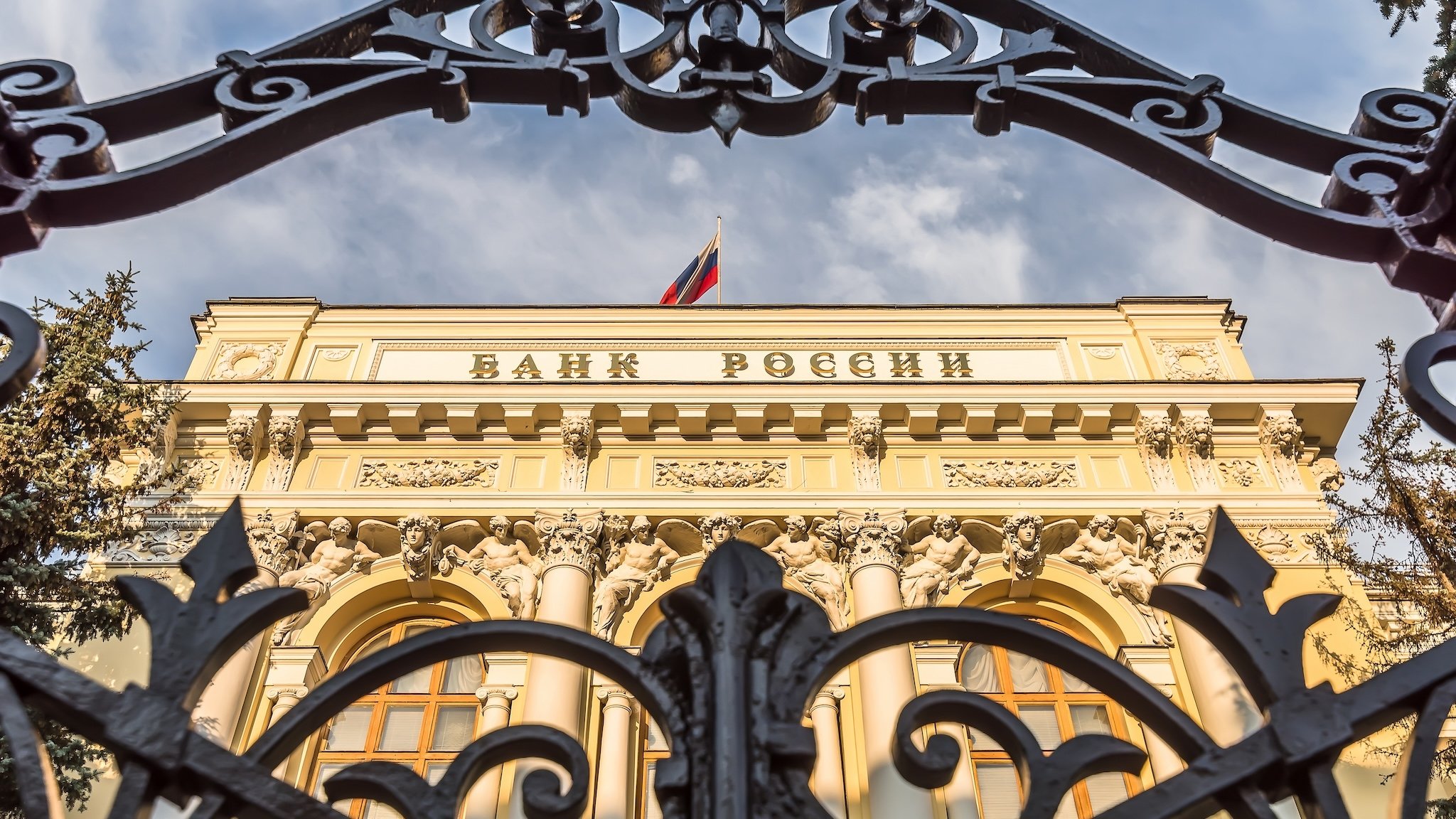
The EU has frozen 210 billion in Russian central bank assets. Brussels is currently planning to funnel the proceeds to help rebuild Ukraine. But why not use all the money as reparations? Patrick Heinemann believes this is legally possible.
• Zur deutschen Textfassung geht es hier.
Before the start of the war and the associated sanctions against Russia, European countries had to pay for Russian gas deliveries in Western currencies rather than rubles. As a result, around 210 billion euros are now held in the European Union (EU), of which between 180 and 200 billion euros are held by a clearing company in Belgium. Since Russia's invasion of Ukraine, those funds have been frozen, so that Russia can't access them. Under the slogan "Make Russia Pay", a lot of people are currently calling for this money to be made available to Ukraine.
According to the principles of state responsibility, Russia owes Ukraine even greater reparations: as early as March 2023, the World Bank estimated the damage caused to Ukraine by Russia's war of aggression in violation of international law at around 411 billion euros. Ukraine needs financial assistance: Its main donor, the USA, is currently engaged in a domestic political quarrel over immigration policy. Therefore, the proposed aid package for Ukraine has been postponed.
It remains to be seen whether an agreement will even be reached before the presidential elections in November – and what a Trump presidency could mean for Ukraine. Transferring Russian assets to Kyiv would therefore not only weaken the Kremlin, but also provide Ukraine with more financial security. It is therefore not surprising that the Biden administration is promoting this within the G7.
German government is afraid of Russia's reaction
However, the German government does not seem to be convinced, at least not yet. Economic and legal arguments are being discussed behind closed doors. Above all, Germany fears that other states and investors could withdraw their assets from the eurozone out of concern their money might be seized too. However, Russia's central bank assets have already been frozen for around two years without a single country pulling its assets out of Europe.
The former World Bank President Robert Zoellick has recently argued that a joint move of EU and G7 countries to confiscate Russian central bank assets, would leave the likes of China, Saudi Arabia or India with no alternative but to invest their money elsewhere,. Moreover, this step is not being considered as a sanction against any behavior that violates international law, but as reparation for the most serious injustice. Another economic argument is the fear that Russia could retaliate by confiscating Western assets in Russia. However, the question must be asked whether German foreign and security policy should seriously consider western companies that continue to operate in Russia two years after the full-scale invasion of Ukraine. The risk of investing in a dictatorship like Russia and the corresponding liability should coincide here.
Sovereign states generally do not need authorization
It would not be convincing to dismiss the objections to such a step under international law as legalism or to place morality above the law in view of Russia's crimes against Ukraine. That is not the point here: the legal arguments put forward against the confiscation of Russian central bank assets don't hold water either. There is no provision in international law that prohibits such a step. According to the so-called Lotus principle of international law, a state’s freedom to exercise its sovereignty is only limited by prohibitive rules to which the state in question has consented. The G7 countries would therefore not need any explicit authorization under international law; it is sufficient that there is no prohibition on transferring the money to Ukraine.
Russian state assets not sacrosanct under international law
However, it is often said that state-owned assets enjoy special protection under international law and are unequivocally immune. This is contradicted by pragmatic considerations: If this were the case, why has the EU frozen Russian central bank assets for around two years in response to the full-scale invasion of Ukraine and is now considering funneling the proceeds to Ukraine? This is difficult to reconcile with the notion that Russian state assets are sacrosanct.
Above all, however, this argument is flawed. This applies in particular to the repeatedly cited principle of state immunity, to which Advocate General Juliane Kokott also referred in an article for LTO. It is recognized under international law that states enjoy immunity from the jurisdiction of another state. The principle of state immunity limits the exercise of jurisdiction of a state in relation to other states. However, the exercise of the other powers, i.e., the executive and the legislature, is not limited externally. If a sovereign state such as Germany decides to act by law against another sovereign state such as Russia and confiscate its central bank assets located in Germany, the question of sovereign immunity does not even arise. The Russian state does not enjoy general immunity vis-à-vis the German state, but only before German courts.
No investment protection for the Russian Central Bank
International investment law also does not prevent the confiscation of the Russian state assets. There is a bilateral investment treaty between the Soviet Union and the Federal Republic of Germany from 1989, which continues to apply to Russia today. However, this treaty does not protect the Russian Central Bank as a state actor of the Russian Federation.
The treaty protects "investors". This can only be understood to mean private investors. Bilateral investment treaties are intended to protect private investors from the two contracting states, but not the two contracting states themselves.
Nothing else applies to the general rules of international investment law, the "minimum standards of treatment". The existence of such "minimum standards" is recognized under customary international law. However, there is no sufficient state practice on the question of what constitutes minimum standards.
Nor are Russian central bank assets protected by the principle of inviolability. This refers to the inviolability of state property that serves a diplomatic mission. That is not the issue here.
Appropriate countermeasure
The confiscation of Russian central bank assets can be classified as a so-called countermeasure under international law. Sanctions or "restrictive measures", as they are known in EU jargon, are only one form of countermeasure. It is therefore also irrelevant that the confiscation of Russian central bank assets is no longer covered by the concept of (fundamentally reversible) economic sanctions. It is generally accepted that the Draft Articles on Responsibility of States for Internationally Wrongful Acts (ARSIWA) of the International Law Commission (ILC) reflect customary international law on countermeasures.
In particular, countermeasures must be proportionate to the harm suffered. This is the case with the confiscation of Russian central bank assets: Russia is waging a war of aggression against Ukraine with at least genocidal elements, which violates many fundamental rules of international law. Moreover, the amount of central bank assets to be confiscated is nowhere near the amount of damage that Russia has inflicted on Ukraine through the war of aggression. Nor did milder measures, such as the freezing of central bank assets, succeed in persuading the Russian Federation to stop its war of aggression or even compensate for the resulting damage.
It should also be noted that this is exclusively about the confiscation of Russian state assets, whereas the Russian Federation began confiscating private Western assets some time ago, as in the case of Danone and Carlsberg. Countermeasures may only aim at persuading a state to act in accordance with international law. However, it is possible that the prospect of losing the frozen central bank assets to Ukraine will exert pressure on Russia not to continue its war. In addition, confiscation would pursue the goal of persuading Russia to comply with international law, as it could be used to partially settle its war debts to Ukraine.
Russia's counterclaims not justified
Therefore, there is no need to fear justified counterclaims by Russia: Russia cannot suffer irreparable damage if its central bank assets are transferred to Ukraine. The Russian Federation is under an obligation to make full reparation to Ukraine in accordance with the principles of state responsibility. The amount of these payments far exceeds the value of the state assets to be confiscated. If the assets are confiscated and transferred to Ukraine, this does not harm Russia, but partially relieves it of its debt to Ukraine.
Further objections concern the question of the extent to which states other than Ukraine may take measures against Russia. According to the ARSIWA, states are called upon to cooperate to bring an end to any serious breach of obligations under peremptory norms of general international law, such as those committed by Russia against Ukraine. It is true that the ARSIWA initially assume that those states that are themselves affected by the internationally wrongful act (injured states) may take countermeasures.
However, Art. 48 No. 1 lit. b ARSIWA also allows states other than an injured state to invoke the responsibility for acts if the obligation breached is owed to the international community as a whole. This is generally assumed in the case of serious violations such as the violation of the prohibition on the use of force. In particular, third states may claim the performance of the obligation of reparation in the interest of the injured state. Finally, the ILC has clarified in its own commentary that the provisions on countermeasures are not exhaustive, but open to further development.
No problems under German constitutional law
German law also does not preclude the confiscation of Russian state assets. According to the principle of conferral, the EU has no competence to act in this area itself. The provisions on restrictive measures (Art. 215 TFEU) are clearly aimed at economic sanctions; the confiscation and transfer of Russian state assets to Ukraine would probably go beyond this. As a result, Germany and the other member states would have to take action at national level, although it would make sense to coordinate such a step internationally within the framework of the EU and G7.
Concerns that Russian state assets might only be transferred to Ukraine after very lengthy judicial proceedings are also unjustified. In any case, the confiscation of Russian state assets would not affect fundamental rights of the Basic Law for the Federal Republic of Germany. This is because neither the Russian Federation nor its central bank are entitled to fundamental rights. They can therefore not invoke Article 19 (4) of the Basic Law, which guarantees the right to effective legal protection. Important decisions such as the confiscation of the central bank assets located in Germany must be taken by the German Bundestag in a Federal Law. This could be a self-executing treaty, so that no further administrative acts would be required that Russia could challenge in court. Germany would by no means be alone with such an approach: The current US draft law on the transfer of frozen Russian assets to Ukraine (Rebuilding Economic Prosperity and Opportunity for Ukrainians/REPO for Ukrainians) explicitly states that the confiscation of Russian assets shall not be subject to judicial review.
No serious objections to confiscation
Russia's threats to thwart or at least delay the transfer of the central bank's assets to Ukraine through years of legal disputes are therefore unconvincing. Even constitutional complaints by Russia or its central bank against such a confiscation law would not be admissible because neither can invoke fundamental rights. The fundamental rights of the Basic Law are not there to protect foreign states from a sovereign German foreign policy. Therefore, there is no serious prospect that the Federal Constitutional Court may issue a temporary injunction that temporarily suspends a statutory confiscation. In addition, the application based on § 32 BVerfGG is generally subject to strict requirements in the case of parliamentary laws.
As a result, there are neither international nor constitutional concerns about confiscating the Russian assets and transferring them to Ukraine. Such a step would not only be legal, but also urgently needed to ensure Ukraine's resilience. This is not only in Ukraine's interest, but also in Germany's: Should Ukraine collapse, the costs for Europe would be catastrophic in every respect.
This text is a translated and slightly revised version of the article published in German on 31 January 2024.
Transfer of Russian central bank assets to Ukraine: . In: Legal Tribune Online, 09.02.2024 , https://www.lto.de/persistent/a_id/53843 (abgerufen am: 27.07.2024 )
Infos zum Zitiervorschlag


